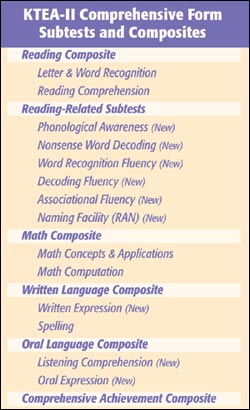
For educational teams who need a broad measure of listening, speaking, reading, writing, and math skills—including two parallel forms, one measure of rapid automatized naming, story-based Written Expression measurement, and norm-referenced error analysis, and a Brief Form—the KTEA-II is an individually-administered measure of academic achievement for children, adolescents, and young adults.A newer version of the KTEA is available.
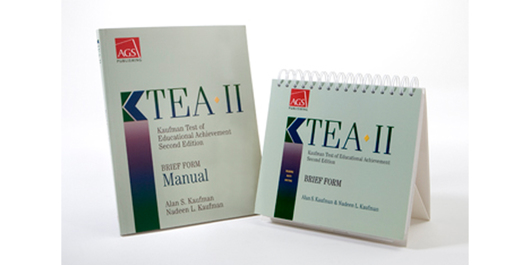
 Activate to view the image in zoom mode
Kaufman Test of Educational Achievement | Second Edition
KTEA-II
For educational teams who need a broad measure of listening, speaking, reading, writing, and math skills—including two parallel forms, one measure of rapid automatized naming, story-based Written Expression measurement, and norm-referenced error analysis, and a Brief Form—the KTEA-II is an individually-administered measure of academic achievement for children, adolescents, and young adults.A newer version of the KTEA is available.Overview
Product Details
- Publication date:
- 2004
- Age range:
- 4:6-25:0
- Scores/interpretation:
- Age- and grade-based standard scores (M=100, SD=15), age and grade equivalents, percentile ranks, normal curve equivalents (NCEs), stanines, and Growth Scale Values (GSV)
- Qualification level:
- B
- Completion time:
- Pre-K: 30 minutes; Grades 1-2: 50 minutes; Grades 3 : 80 minutes
- Administration:
- Paper-and-pencil
- Scoring options:
- Manual Scoring
If you need a brief ability test, choose the Kaufman Brief Intelligence Test | Second Edition (KBIT-2). It is co-normed with KTEA-II Brief for ages 26 through 90.
Features
KTEA-II features alternate forms to measure student progress or response to intervention and to adjust instruction based on performance, as well as:
- Comprehensive Form for in-depth analysis.
- Expanded age range (4-6 to 25 years) for a thorough assessment of preschoolers to adults.
- Written Expression and Oral Expression subtests that use engaging stories or situations.
- Comparisons of skill areas or subtests for easy interpretation of results.
- Enhanced content coverage in math.
- Best practices instructional suggestions for designing IEP goals that match students’ score information with remediation strategies.
- Comprehensive and Brief Forms meet in-depth or quick assessment needs.
Resources
This document includes instructions for making corrections to the Error Analysis sections of four KTEA-II subtests.